|
Woman abroad: Being desi
By Maheen
A. Rashdi
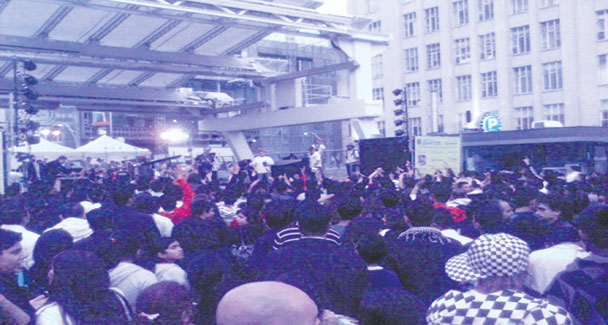
The desifest is an annual event taking place in Toronto since the
past three years.
South Asians in Canada definitely need more cultural space, not to
mention a lot of attention. And perhaps it was with these
considerations that the month of May 2009 in Toronto was declared
the Asian Heritage Month.
When more than 200 ethnic origins are vying for recognition in one
city, re-visiting your roots becomes more than just a taste of your
own culture. It turns into a necessity because defining your vibrant
identity might just give the much-needed edge in a dazzling sea of
culture. And in Canada, where 13.5 per cent of the population is
categorised as being ‘the visible minority’, that ‘edge’ is a vital
tool for success.
Toronto’s South Asian community is reportedly the fastest growing
visible minority group in the city. Moreover, the last prediction
from Statistics Canada is that by ‘the year 2017, more than one
million South Asians will call Toronto home.’ That will be changing
the demographics to turn South Asians from a visible minority to a
very visible majority, and ‘making this city the largest diaspora in
the western hemisphere,’ reports the Canadian Broadcast Corporation
(CBC).
These are a lot of statistics to prove that South Asians in Canada
definitely need more cultural space, not to mention a lot of
attention. And perhaps it was with these considerations that the
month of May, 2009 in Toronto was declared the Asian Heritage Month,
which culminated in a 12-hour free concert at Yonge and Dundas
Square, which for a better understanding may ‘allegedly’ be called
the Times Square of Toronto.
The desifest is actually an annual event now taking place since the
past three years. Needless to point out that it offers an array of
everything desi. From eatables like pani puri, bhutta and tikka boti
(all sold at exorbitant rates) to chappals, silver jewellery and
fake gold jhumkas (all of which seem to be imported from the
roadside bazaars of Karachi or Lahore), there is an assortment of
desi materials for anybody willing to be fleeced. But one would need
to feel very, very nostalgic to agree to buying Rs10 worth of bhutta
for $8, Rs150 chappals for $10 and a Rs200 small stole (shawl) for
$12.
However, being fully charged with the ‘it’s the time to disco’
ambience, South Asians — or to be precise, Indians and Pakistanis —
throng the event in hordes to drink in the desiness of it all and to
enjoy the bhangra rap which resonates throughout the day around
downtown Toronto. The fest revolves around the 12-hour concert from
11:00 am to 11:00 pm which features local talent of desi origin who
mostly reign within the community. As a treat, usually a star of
international repute is called in to grace the event which this time
happened to be Raghav who has been on the international music charts
since 2004.
And I think it was primarily Raghav’s attraction which brought out
the crowds despite rain predictions.
And since in Toronto, weather predictions most often come true, the
rain did come down hard, blowing away the marquee and halting the
concert and sending the crowd scurrying under any available shelter
— but only for a brief period. True to the resilient nature of
Torontonians against the weather, the crowd of South Asians stuck it
out and were back in form — a little wet but undaunted — waiting for
the star performer. And he too kept his promise and showed up on
time to wrap up the evening, or rather the month, of desi
celebrations ending on his famous number, “Work it out…”
Issues of identity, finding a voice, and having a more visible
presence in both politics and the media are still very compelling
for South Asians in Canada despite having such a large presence.
Those who are willing to compromise on status and begin at the lower
rung and don’t have a language barrier have persevered and broken
into the mainstream market even in the media, which perhaps is the
most ‘closeted’ industry of them all.
Since immigration accounts for more than 50 per cent of Canada’s
population growth with immigrants coming mainly from Asia and the
Middle East, it is more a necessity now for the government to create
such programmes to show their ‘solidarity’ with South Asians. In
fact the South Asian Heritage month was an initiative of the South
Asian Heritage Foundation, a non-profit corporation which, according
to their website, was ‘formed to give spirit to the South Asian
Heritage Act, 2001 in the Ontario Legislature’.
The forecast is that after 2025, Canada’s population growth will be
based solely on immigration. The government is probably going to be
even more geared towards wooing the South Asian community’s vote
bank, making much such investment to promote the community and build
its goodwill. South Asians in turn can and should take advantage and
work out ways to integrate into society more effectively.
1 The rain drenched venue
2 Raghav draws the crowds
DAWN Review:Sunday, 14 Jun, 2009 |