Sufi Film Aims To Show Gentler Side Of Islam
'Kashf: The Lifting Of The Veil' focuses on the human face of
Pakistan and its cultural heritage of Sufism and Spirituality
By Robert Duncan 
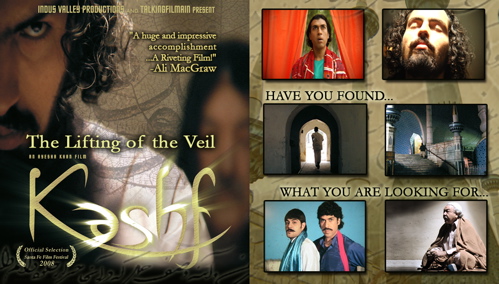
A film about Sufism from a region better known for the Taliban aims
to show a gentler side of Islam. The film, "Kashf: The Lifting Of
The Veil," is described as the first English-speaking feature film
from Pakistan in 30 years and is being distributed by "Spiritual
Cinema Circle."
According to an article at "CHUP! – Changing Up Pakistan", "the
movie explores Sufism - the mystical side of Islam- through the eyes
of Armaghan, who was born after an oath his mother made to a Sufi
Pir when she was childless. Armaghan’s mother promises the Pir, who
blesses her, to let her son ‘walk the Sufi path’ when he grows up.
However, he returns to Pakistan from America after 25 years, unaware
of the secret about to change his life."
Sufism is not a Islamic denomination, but rather a mystical-ascetic
form of Islam. Followers of Sufism aim to focus on the more
spiritual aspects of Islam and to obtain direct experience of God by
being trained how to used what are described as "intuitive and
emotional faculties."
While Sufism and Islamic law are considered to be complementary,
Sufism is criticized by more fundamentalist Muslims - such as
followers of Wahhabism - as being a heretical innovation of Islam.
Kashf, the film's website claims, "is a story of universal relevance
exploring humanity’s basic questions of who we are, and why we are
here." The film's promoters say they hope that once viewers see the
film they will "ask if Sufism and its history in Pakistan can stem
the tide of extremism and the Taliban."
Pakistan since before the 12th century. It permeates and enriches
our culture and our identity in ways which are visceral and we
should as a nation be determined to preserve that." Later in that
interview, Khan added, "If the government was serious in its intent
and reached out with a long term goal of education to people in
Pakistan and providing means with which they could be economically
viable, the elements at risk would themselves realize the fabulously
coined label of Taliban are nothing but thugs who are hiding behind
a façade of Islam which has nothing to do with the practice of
Islam."
Besides Khan, actress Ali MacGraw also lives in Santa Fe. Kashf's
promoters say MacGraw saw the film at the Santa Fe Film Festival and
called it "a huge and impressive accomplishment. I was fascinated to
see the many aspects of Pakistan which are not normally accessible
to us on our television reportage ... a riveting film."
In recent years MacGraw has been known as a proponent of Hatha Yoga
and her "Yoga Mind and Body," and was credited in June 2007 by
Vanity Fair as being one of the people responsible for the yoga's
popularity in the United States.
Kashf was nominated for Best Editing at The Santa Fe Festival, and
is currently playing in various Art House Theaters and various
universities, including Brown, Stanford, NYU and Columbia.
Film Distributed By New Age Subscription Company
Kashf is being distributed over the internet by the New Age internet
DVD subscription company Spiritual Cinema Circle.
In an online interview at OrganicAuthority.com, Spiritual Cinema
Circle co-founder Stephen Simon said, "We see Spiritual Cinema as
the 21st Century version of shamanic storytelling - with filmmakers
as the modern day shamans, sitting around a celluloid campfire,
passing down the myths and hopes of a culture from one generation to
another."
Spiritual Cinema Circle has previously distributed films such as
"What the Bleep Do We Know," "The Secret," and "Conversations With
God."
In that same interview, Simon said his company seeks to
differentiate between "Religion" and "Spirituality."
"'Religion' reflects the teachings of particular organized religions
that commonly present specific rules, regulations, and rituals that
must be followed in order to experience a connection with the Divine
which is usually identified as male and outside of humanity.
'Spirituality' entails a more personal, inner-directed, and
individual experience of the Divine, which is represented as an
integral aspect of our own humanity. The Passion would be a classic
example of Religious Cinema while Whale Rider would be a prime
example of Spiritual Cinema," Simon was quoted as saying.
"Spiritual Cinema illuminates the landscape of our evolution and
stirs us to remember who we can be when we reach beyond the seen
into a realm where we engage the magical aspects of our human
potential," Simon said elsewhere in that interview.
In that vein, Kashf is described as exploring "one man’s journey
towards Sufism, the mystical side of Islam. In the midst of
worldwide headlines of the Taliban, 'Kashf: The Lifting Of The Veil'
focuses on the human face of Pakistan and its cultural heritage of
Sufism and Spirituality."
Robert Steven Duncan is a consultant and a widely published foreign
correspondent who lives in Spain. Besides having articles appearing
in WSJ, Barron's, Smart Money, Newsweek, the National Catholic
Register and many other places, he has held various leadership posts
in the communication sector. He publishes the "RSD Report" at
http://www.robertstevenduncan.com
The views and opinions expressed herein are those of the author
only, not of Spero News.
Source.www.speroforum.com
Thursday, May 21, 2009
|